
From your idea to running software.
You make the business decisions. A coordinated team of AI agents plans, builds, reviews, tests and releases the software.
Six steps, and what each one asks of you.
At every step: what you provide, what 19 Agents does, what you get back, and which decisions are yours.
Describe the outcome
- You provide
- Your idea in plain words: who it is for, the problem it solves, and what it should do.
- 19 Agents does
- Reads the idea and starts a project for it.
- You receive
- A project with your idea as its starting point.
- Your approval
- None yet.
Real screen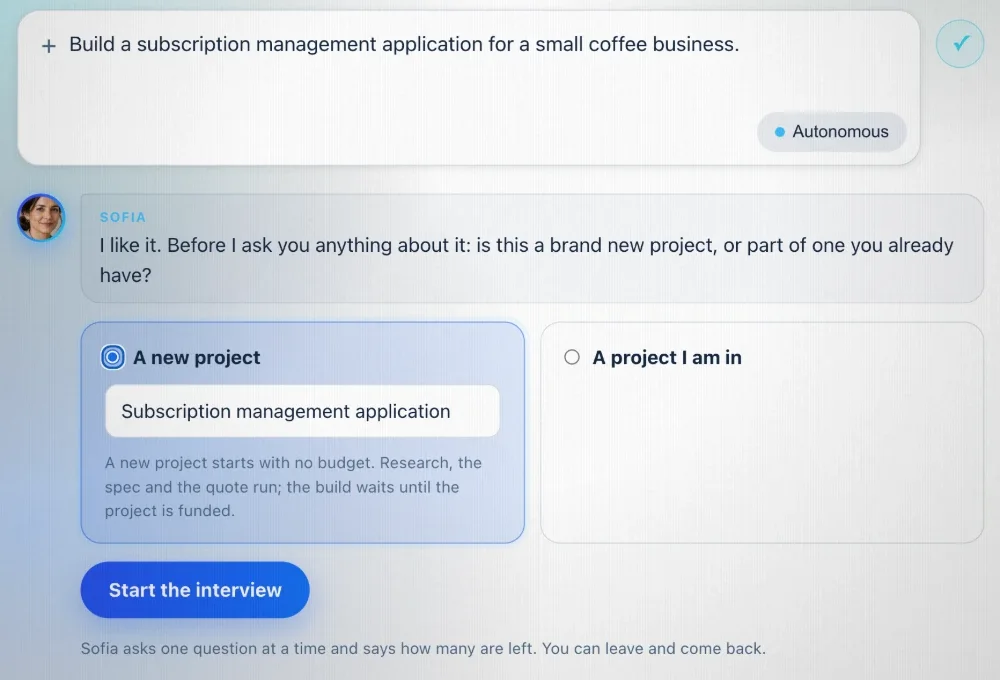
Clarify requirements and scope
- You provide
- Answers to the agents' questions about how the product should behave and what matters most.
- 19 Agents does
- Researches the idea and writes a specification of what will be built, and what will not.
- You receive
- A written scope you can read and correct, and designs where the product has screens.
- Your approval
- The designs, by default. You choose whether the specification also waits for you.
Review the plan and approve the fixed price
- You provide
- Your decision.
- 19 Agents does
- Breaks the scope into work items and prices it.
- You receive
- One fixed price for the accepted scope, a forecast delivery window, and the Run tier the product falls under, from its scope, performance and scale, with its monthly price if you choose to have 19 Agents run it after it is built.
- Your approval
- The scope and the price. You approve it yourself, or let quotes under a limit you choose be accepted automatically. Nothing is built before it.
Real screen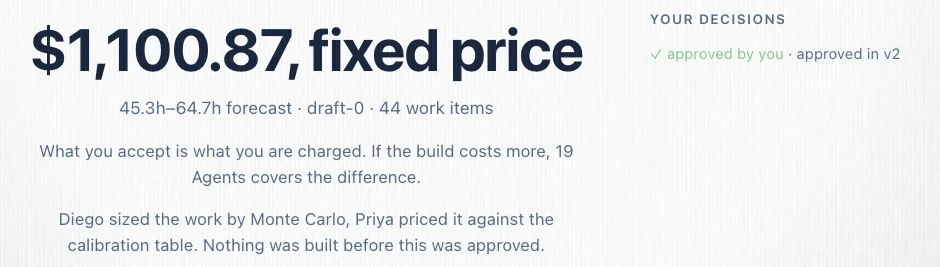
Agents build, review and test the application
- You provide
- Nothing, unless a question comes back to you.
- 19 Agents does
- Engineering agents write the code; separate agents review it and test it. Work that fails goes back for fixes.
- You receive
- Progress you can follow, with the recorded evidence of each piece of work: reviewed, tested, passed or not.
- Your approval
- Only the questions the agents cannot settle themselves.
Real screen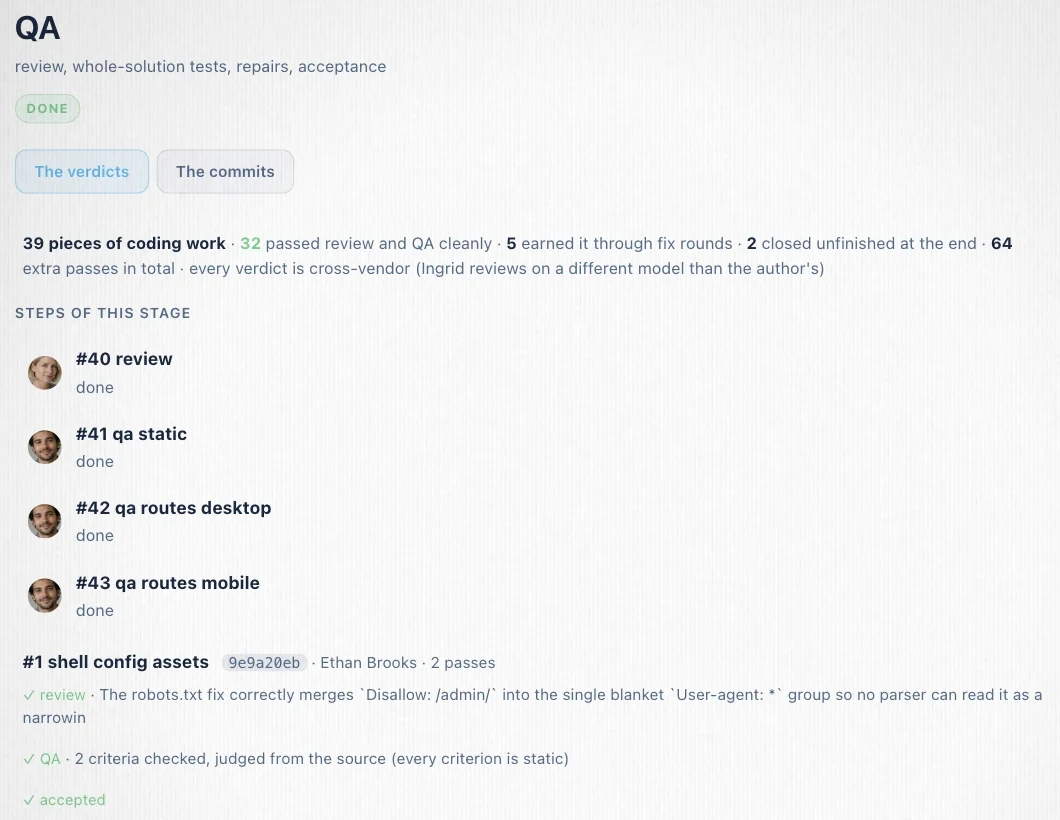
Review the release and how it will run
- You provide
- Your review of the result, and any accounts the product needs, such as payments.
- 19 Agents does
- Runs the readiness checks and prepares the release and its hosting.
- You receive
- The product ready to go live, at an address 19 Agents provides or on a domain you already own.
- Your approval
- The release, by default. Nothing goes live until you say so.
Real screen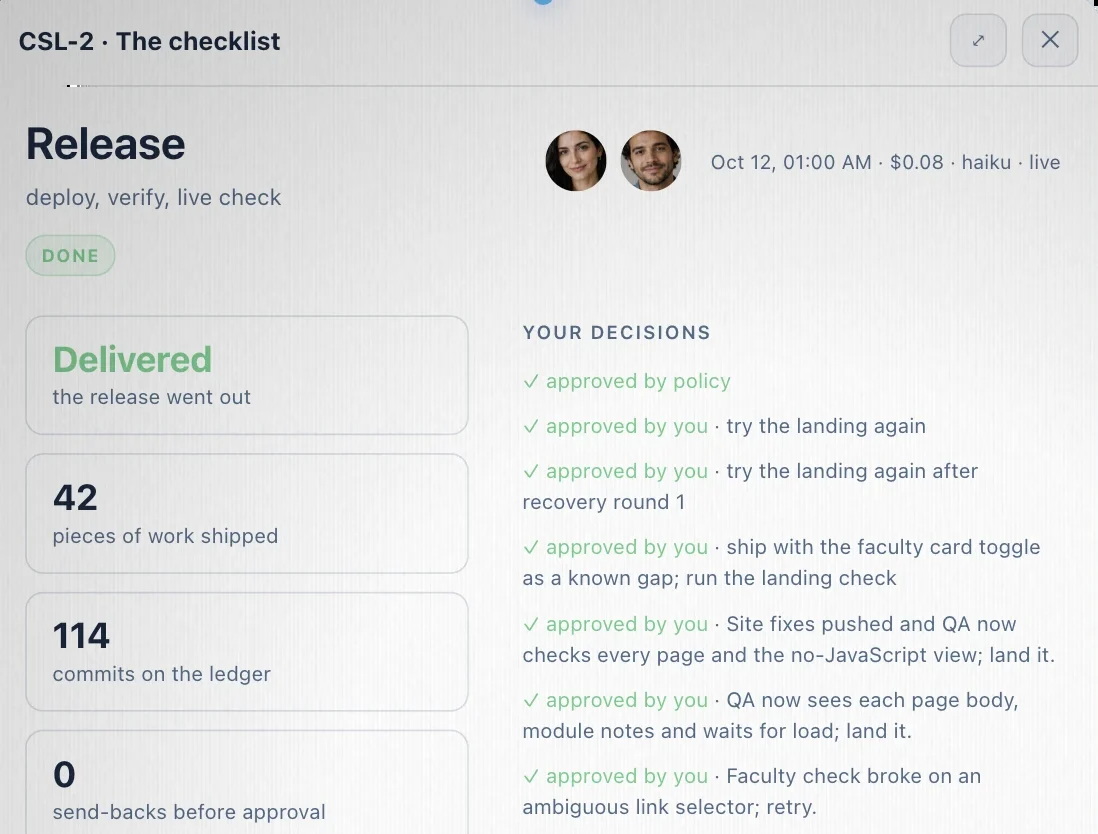
Continue improving the product
- You provide
- The next feature, fix or change you want.
- 19 Agents does
- Plans it on the same product, with the history of everything built before.
- You receive
- A new quote for the change.
- Your approval
- The new scope and price, as with the first build.
Real screen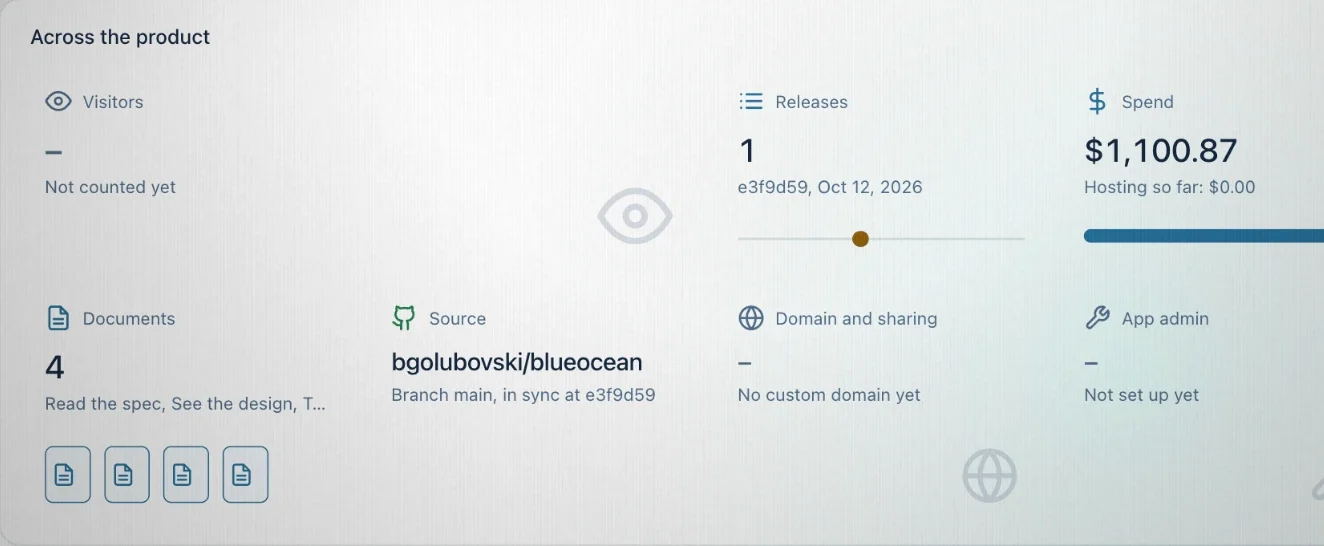
Approvals shown are the default setting. You can ask to be consulted at more steps, or fewer. The scope and price wait for you, unless you set a limit under which quotes are accepted automatically.
One builder. A whole team of AI agents behind them.
19 Agents gives its agents roles, not just prompts. Give them a mission and watch them split it.
Add gift cards to the roastery shop
- SpecRequirements and acceptance criteria
- FeasibilityEngineering spec
- BudgetQuote: $315 to $410
- EngineeringBuy and send a gift card, with Stripe, on its own branch
- EngineeringRedeem at checkout, on its own branch
- ReviewBoth changes reviewed
- QA14 end-to-end tests, all passing
- ReleaseProduction deployment
The orchestrator coordinates the work between the gates you hold. These are the roles in the product today, not a mock-up; the mission and its figures are illustrative.
The path to production
Understand
You describe the product. 19 Agents asks the questions a good engineer would ask before writing anything.
In the product:IdeaDiscovery
Plan
Requirements, then an engineering spec: architecture, dependencies, the task list, the services to connect. Then the designs, and what it will cost and when it lands.
In the product:RequirementsEngineering specDesignQuote
Build
Architecture first, then frontend, backend, data, integrations, auth and security, in parallel, each change reviewed before it lands.
In the product:ArchitectureBuildIntegrationsAuthSecurityCode review
Test
End-to-end tests run the acceptance criteria against the running product before anything reaches production.
In the product:End-to-end tests
Deploy
A real production environment, provisioned and verified.
In the product:Release
Run
Logs, health, costs and fixes, in one place.
In the product:Measure
Improve
Give 19 Agents the next feature. Same application, same history, and the loop starts again at the idea.
In the product:Idea
Seven stages in plain words. In the product each one is one or more parts, done by the roles in the roster, and a stage can hold many steps.
Build it. Then keep building it.
Anyone can generate a v1 now. The question is what happens at v27.
- Day 1
Build a marketplace for local photographers.
19 Agents builds it.
- Week 3
Add Stripe Connect and photographer payouts.
19 Agents changes the product that is already in production.
- Month 2
Introduce team accounts.
19 Agents reads the architecture it built and extends it.
- Month 6
Move the image pipeline to Cloudflare.
Same application. Same codebase. Same history.
A product isn't one prompt. 19 Agents stays for the whole journey.
You hold the gates.
19 Agents runs the work between gates you configure: the plan, the quote, the release.
Have a software idea worth building?
We're gradually opening 19 Agents to entrepreneurs and business owners who want to build real software without assembling an engineering team.
Join the beta waitlist. Tell us a little about what you're working on, and we'll contact you as we admit new builders.
The beta starts every product from a new idea, with test data rather than real customers'. Already have a product? Tell us about it anyway: we read every request and write when the beta can take it on.
- Experience a working AI-powered software development platform
- Explore scope and fixed-price quoting before development
- Get direct contact with the founding team during the closed beta
Investor or potential partner? Contact the founders